Memory pricing has become an important part of planning a computer build again. Yet several steps separate an analyst forecast from the price of a particular DDR5 kit in a local store. Understanding those steps is more useful than trying to identify one perfect purchase date. Sources for this article were checked on October 18, 2026. Any outlook discussed here remains a forecast rather than a promise about future prices.
What the fourth-quarter forecast says
In its September 30 report, TrendForce projects a 10–15% quarter-on-quarter increase in conventional DRAM contract prices, linking tight supply to the priority given to server products. That is an assessment of chips and large purchasing agreements, rather than a measurement of every retail memory kit. [s0]
It does not follow that every module will rise by precisely that percentage. Stores sell batches purchased at different times. Their inventory, supply agreements and currency costs also differ. An individual listing can fall during a clearance sale while average procurement costs are already moving higher. There is no contradiction: those observations concern different stages of the market and different moments in time.
Why servers can affect a home computer
Desktop memory and the memory used by an accelerator are not interchangeable products. A server memory stack cannot simply replace an ordinary DIMM. Semiconductor manufacturing nevertheless shares an economic foundation: investment, equipment, process qualification and the allocation of resources. Large customers willing to commit money and volumes in advance can leave consumer buyers with less negotiating flexibility.
Explaining everything with the letters “AI” would still be too simple. Final prices also depend on the number of available suppliers, stocks held by module manufacturers and demand for particular generations. New systems adopting DDR5 do not make an older motherboard compatible with it. Consequently, difficulty finding a suitable kit for an existing computer can feel more severe than the movement in a broad market indicator.
Contracts, spot trades and shops tell different stories
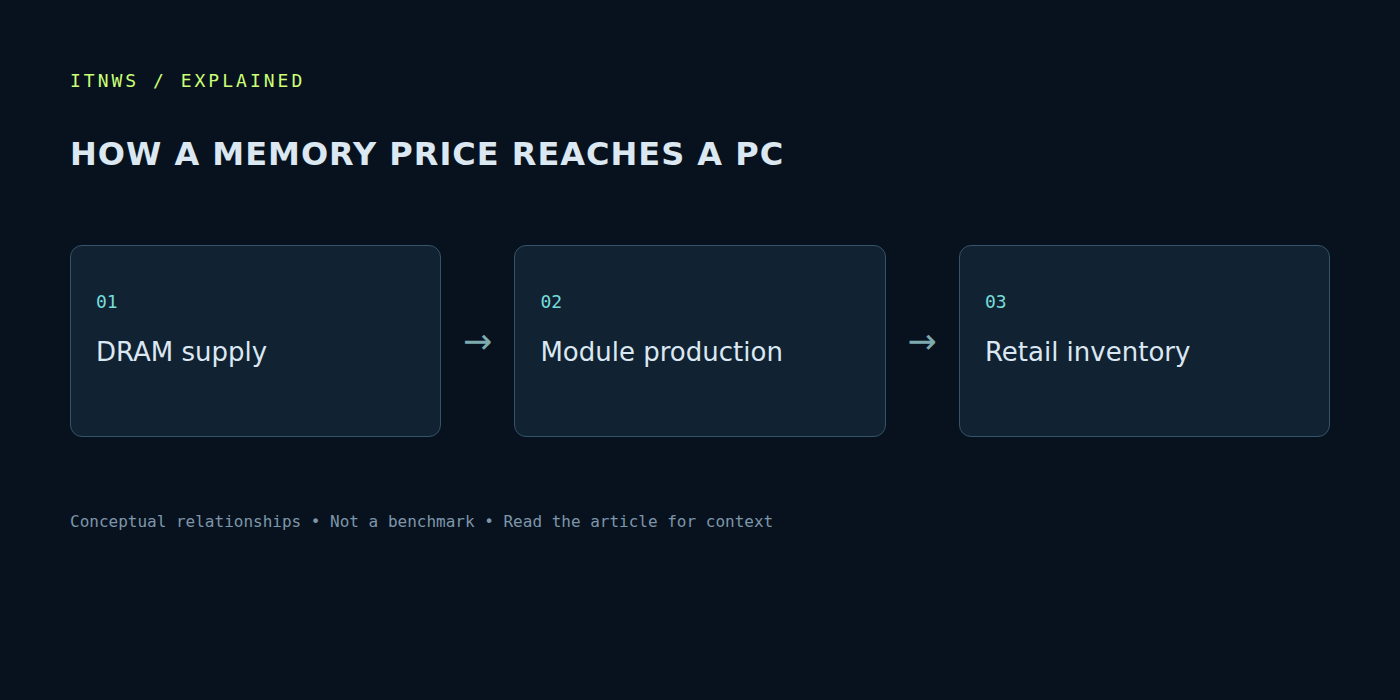
A contract price concerns an agreed supply arrangement between businesses. Spot transactions concern available volumes over a shorter horizon. Retail pricing adds the finished module board, validation, logistics, warranty and the seller’s operating costs. Watching only one indicator can make a local discount look like a market-wide reversal, or suggest an immediate increase where older inventory is still available.
Consider a hypothetical example. If memory chips represent only part of a kit’s cost, a change in chip pricing need not pass through to the finished product in exactly the same proportion. A currency movement could amplify or offset the local effect. This explains a mechanism; it is not a calculation for a particular brand. A valid comparison needs the same capacity, part number, specifications and warranty conditions.
Establish whether capacity is actually limiting the computer
The practical question starts with workload. If applications routinely push active data into the page file, additional memory can remove noticeable pauses. If there is already sufficient headroom, replacing a kit only for a higher advertised transfer rate may produce a less obvious improvement. Observe the machine during a normal working day, including the browser tabs, editor, game or virtual machines that usually run together.
Not all occupied memory is wasted: the operating system uses otherwise available capacity for caching. More useful signs of pressure are delays, sustained paging and resource shortages during familiar tasks. Recording those observations before an upgrade creates a way to judge the result afterwards. A purchase becomes a clear technical decision when the limiting factor and the success criterion are both known.
Compatibility matters more than the number on the box
Before ordering, identify the exact motherboard or laptop, supported memory generation and controller limits. Module size, chip density, the number of installed modules and BIOS version can affect the supported configuration. Kingston’s discussion of higher-capacity modules illustrates the need for platform support: a matching connector alone is not a complete compatibility check. [s2]
Combining two different kits also does not guarantee the operating profile specified for either kit separately. If stability is the priority, checking documentation and validated configurations is more useful than assuming the maximum overclock will work. After installation, test memory and run real applications. Errors appearing only under a prolonged workload matter more than a small advantage in a brief synthetic benchmark.
Treat the next-year outlook as a scenario
TrendForce’s July outlook describes different possible paths for DRAM and NAND in 2027: DRAM constraints could persist while NAND supply could loosen later. That remains an analyst scenario dependent on demand and new production. It cannot identify the precise day a particular RAM kit will become cheaper. [s1]
A more practical approach is to define several acceptable configurations and compare the full upgrade cost. Include expansion options, warranty, delivery and the risk of ordering an incompatible kit. If the computer is needed for work immediately, waiting for an imagined price bottom has a cost too. If the existing system performs well, there is time to monitor equivalent offers. A market forecast provides context; the decision should follow the actual workload and verified compatibility.