
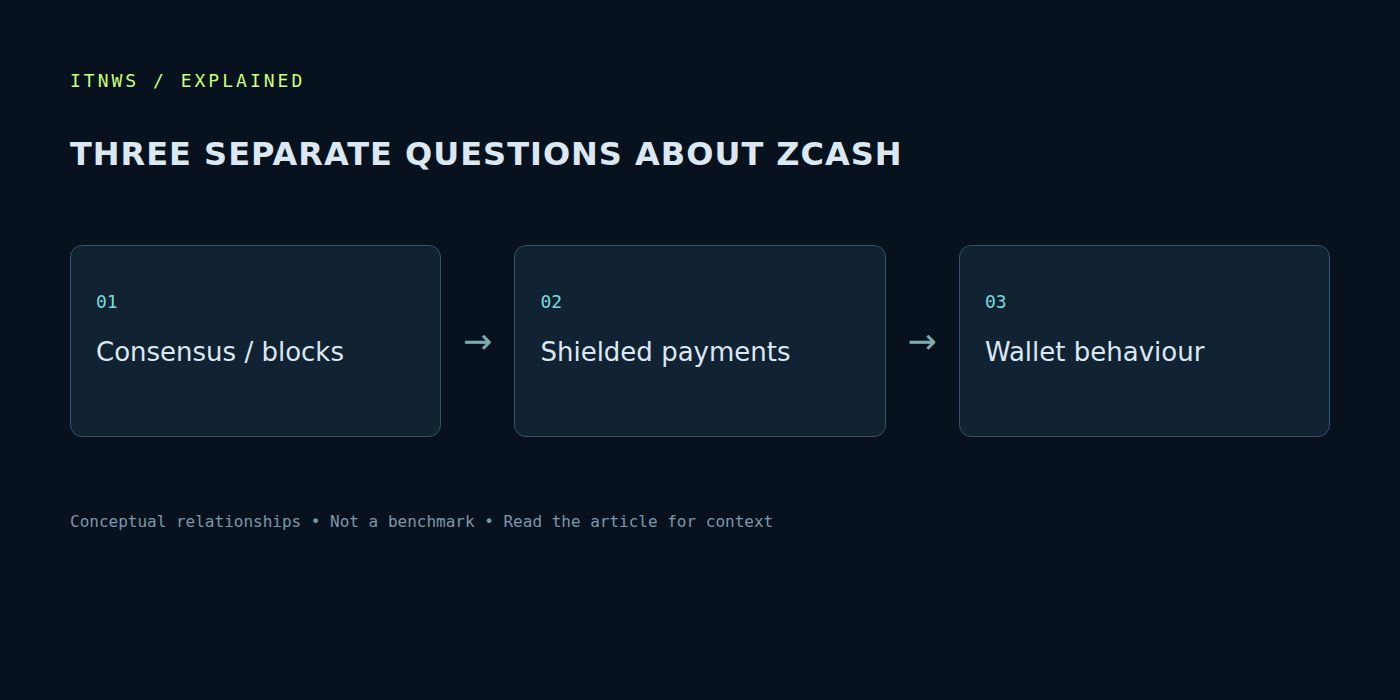
Discussions of Zcash often combine three separate questions: how the network confirms blocks, which payment details are visible and how a person uses a wallet. Separating these levels explains the technology without promising absolute invisibility. This article concerns payment design rather than the price of ZEC. Official explanations were checked on October 18, 2026; an application’s actual features should be checked against its current documentation.
Privacy concerns payment information
Zcash supports shielded operations in which cryptographic proofs establish correctness without publishing the usual set of payment details to every observer. Transparent operations also exist. The network’s name alone therefore does not describe the visibility of a particular transfer. The way it was constructed and any transparent components matter. [s0]
A useful analogy is checking compliance with rules without publishing an entire document. It illustrates the goal rather than replacing the actual proof construction. A node accepts or rejects an operation under network rules. The user need not disclose every detail available in the wallet to a public explorer. System verifiability and universal access to an individual payment history are different requirements.
Shielded and transparent are different modes
A transparent payment exposes the corresponding information publicly. A shielded payment represents information differently. When an operation connects different domains, assess its complete path. A property of the shielded portion cannot automatically be assigned to every action before and afterwards. Zcash’s official learning material separately discusses shielded-transaction visibility. [s2]
Origin and destination matter in practice. A service may support particular address types, maintain its own records and request confirmation of a transaction. Those records exist independently of the public chain. Protocol privacy does not delete correspondence, account history or information voluntarily shared with a recipient. Confidentiality belongs in the context of the complete interaction, rather than one application screen or explorer entry.
The purpose of Unified Addresses
A Unified Address combines receivers of supported types in one address representation. The official explanation connects this with more convenient shielded behaviour in supporting wallets. The actual result still depends on the sending application and available receivers. An address’s appearance does not replace checking the transfer that will actually be made. [s1]
Two applications can present a similar sending flow while supporting different capabilities. Read the confirmation screen and documentation, especially when interacting with an external service. If that service publishes address requirements, they cannot be guessed from a general description of Zcash. The correct network and a supported receiving method are both necessary, but they are separate compatibility checks.
What an explorer can show
An explorer retrieves public chain information and presents it conveniently. Displaying blocks does not grant access to wallet secrets. The absence of a familiar address list inside a shielded component does not mean the transaction is unverified. Conversely, a transaction identifier does not establish that every internal detail is available to an outside observer. What can be displayed depends on the particular operation.
Distinguish confirmation that an operation was included from a complete report about a personal payment. A wallet has information intended for its owner; a public website has what the relevant observer can access. When contacting support, understand which information is actually necessary. Publishing recovery secrets is neither required to confirm a transfer nor a normal diagnostic procedure.
The wallet remains a separate layer
Protocol-level protection does not remove requirements for the device and application. A counterfeit website, an inappropriate installer or compromised account access sits outside a transaction-correctness proof. Verify the application source and understand its recovery procedure. Secrets do not belong in public screenshots or messages to someone offering to “synchronise” a wallet on the owner’s behalf.
Follow the specific wallet’s instructions when changing devices. Versions can differ in backup behaviour and address support. Recovery testing concerns maintaining access, not assessing a coin’s market value. Separately retained payment records also belong in the migration plan. Restoring access and recreating a convenient transaction history in an interface are not necessarily identical operations for every application.
How to assess a privacy claim
A precise technical explanation identifies which information is protected, from whom and under what conditions. A statement that “nobody can know anything” omits recipients, external services and the user’s own behaviour. For Zcash, assess the cryptographic mechanism, transaction type and wallet operation separately. This clarifies where a protocol property ends and the organisation of an interaction begins.
Zcash combines a publicly verifiable network with tools for protecting payment information. Its practical value depends on correct wallet support and understanding the selected mode. This article makes no prediction about ZEC pricing or future returns. Its subject is the technical difference between public information, shielded operations and details disclosed outside the chain itself.