
“A computer for cryptocurrency” says very little about its purpose. One machine validates a chain, another searches for blocks, another stores prepared data and another displays network information on a website. Zcash and Chia make the distinction particularly clear: participation mechanisms differ while some operational questions overlap. Understanding the roles is more useful than selecting equipment from a coin’s name or a vague promise of performance.
What a full node does
A full node independently applies validation rules to network data. Zcash Foundation’s Zebra is a Zcash full-node implementation written in Rust. Starting it does not automatically attach mining hardware or generate rewards. Chain validation and finding a qualifying block should be considered separately. The official repository documents the project’s purpose and operation. [s0]
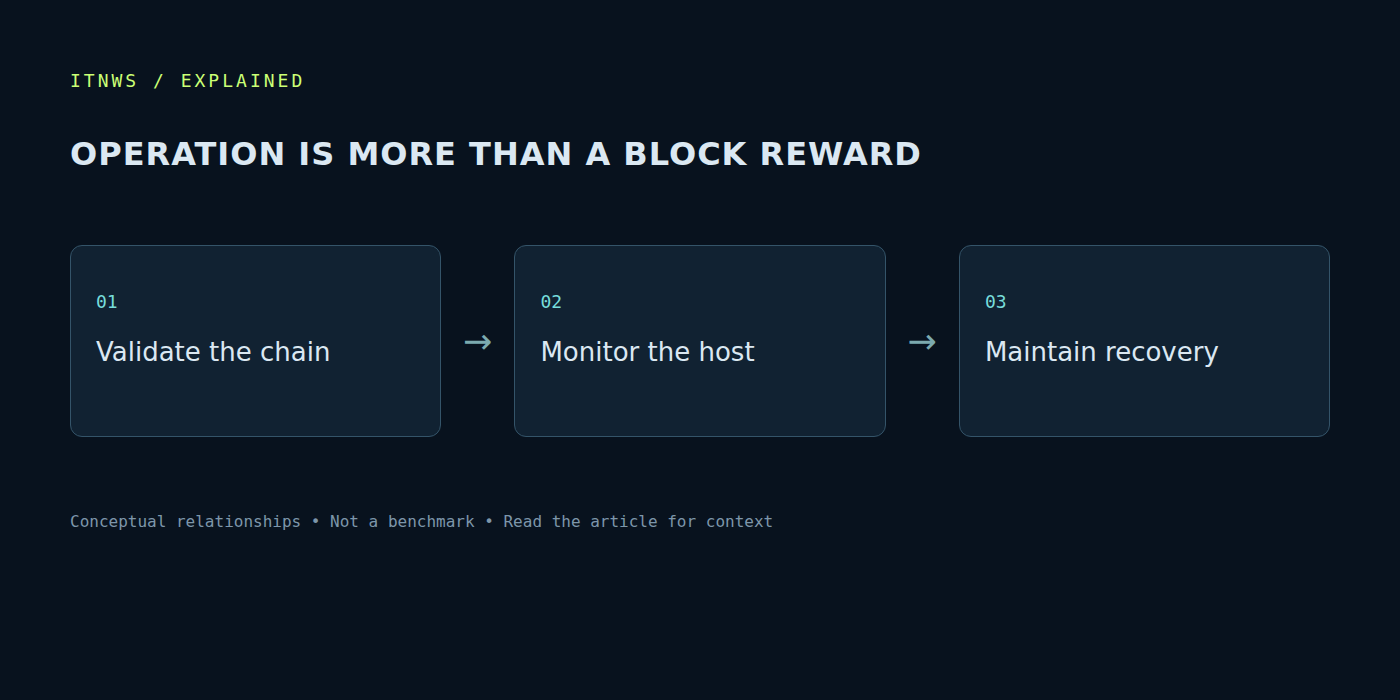
An operator needs to know more than whether a process exists. Is the chain synchronised, does new information continue arriving and are resources adequate? A running program with stale state does not fully perform the expected task. Monitoring should therefore follow actual chain progress and errors rather than merely checking the process list. This can reveal stalled updates even while the service formally remains active.
Mining and an explorer website are different services
Finding a block requires its own job preparation and result validation. A pool additionally tracks participation, distribution rules and the state of found blocks. The website presents information to users; it is not the consensus mechanism itself. A page loading successfully does not establish that every other function works. Conversely, a presentation failure need not stop block searching or validation.
Diagnosis starts by identifying the layer: networking, node, jobs, hardware, accounting or website. Restarting everything erases observations and adds downtime. Clear logs, the time a fault appeared and the state of related services are more useful. This is an engineering approach to finding a cause, not an instruction to change a working installation without a reason. Each change also needs a result check.
Chia distributes the roles differently
Chia documentation describes a full node, farmer and additional harvester machines serving plots. Its consensus uses space and proofs of time, so prepared files belong to a distinct workflow. Those details should not be transferred to Zcash: the shared term “node” does not make block production identical. Each network needs its own explanation of the roles involved. [s1] [s2]
Creating plots, serving them afterwards and validating the chain also impose different workloads. Preparation needs one balance of resources; continued operation needs another. A machine completing the initial stage quickly is not necessarily convenient for sustained use. Slow preparation alone likewise does not establish faulty drives or an inability to operate normally afterwards. Compare behaviour with the requirements of the actual operation.
Assess resources without a universal shopping list
Define each machine’s role first. Measure CPU use, memory, storage operations and network traffic in the relevant mode. Initial synchronisation may differ from normal operation. Preparing data while serving web requests creates another combination. Compare equivalent states; otherwise the hardware conclusion may merely reflect a brief peak rather than the intended daily workload.
Storage needs free capacity, acceptable latency and attention to system errors. Sequential bandwidth cannot describe every database operation or plot lookup. Memory cannot be judged only from occupied capacity either, because the operating system uses caching. Observe available resources and evidence of actual pressure. One number without context rarely explains a slowdown, particularly when other jobs or background updates run concurrently.
Peer networking and administration are separate
A node exchanges information with participants; an administrative interface serves its operator. Public access to management functions is not an automatic requirement of joining a public network. Obtain ports, methods and restrictions from the software documentation and validate them for the installation. A copied configuration may contain assumptions unsuitable for this network or service arrangement.
If a website runs alongside the node, give it only the information it needs. Visitors do not require wallet secrets or broad management access to see statistics. Separating functions simplifies maintenance and diagnosis. When component responsibilities are understood, updating a website does not automatically require stopping the node or rebuilding the entire workflow. Understand those dependencies before maintenance begins.
An update needs outcome validation
Record the current version, data location and configuration-recovery route before changing anything. Read release notes and check compatibility. Afterwards, the new version number is only one observation: synchronisation, data exchange, recurring errors and dependent services matter too. A state-format change needs a documented rollback plan. Copying the executable alone may be insufficient once data have been transformed.
Sources were checked on October 18, 2026. This article promises neither ZEC nor XCH returns and proposes no universal equipment purchase. Its practical idea is to name the task first, then identify the software and observable signs of correct operation. Chain validation, block searching, plot servicing and publishing statistics remain distinct roles even when several run on the same computer.